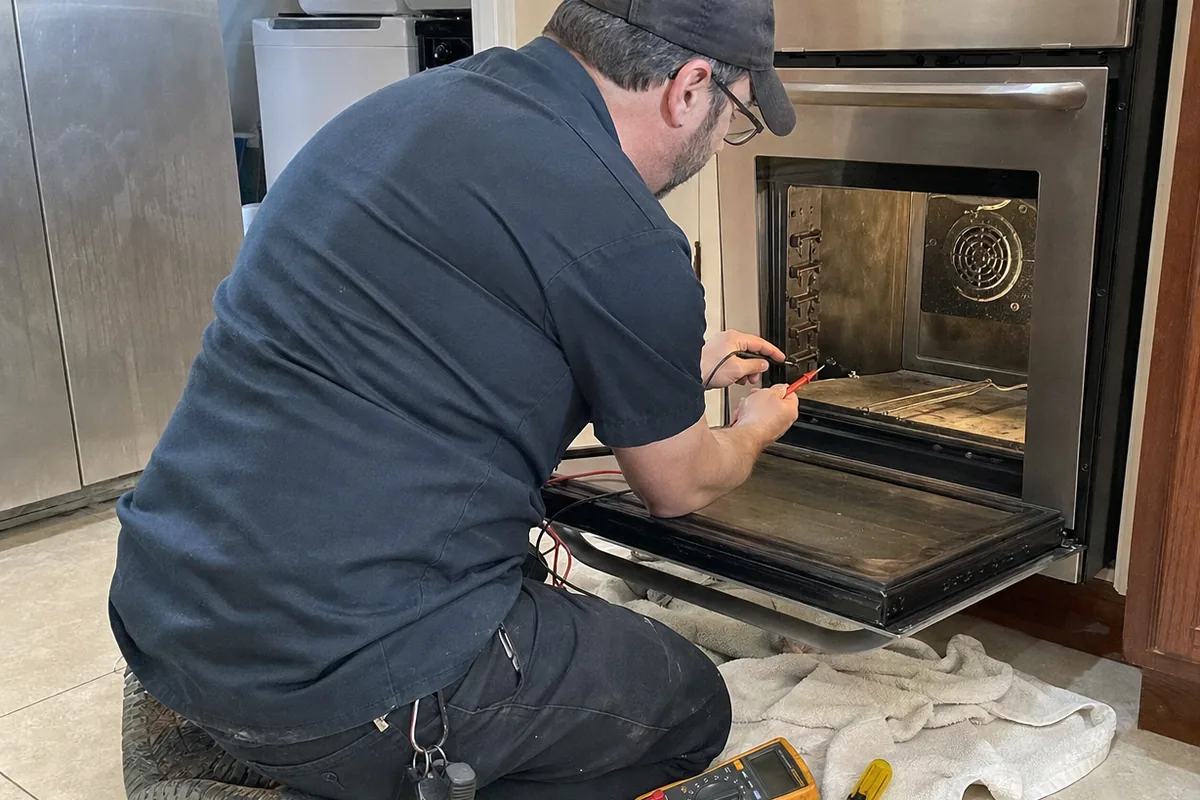
A fault with a very consistent story
The call always arrives the same way. The oven was working. Somebody ran the self-clean cycle, usually before a holiday. The cycle completed, the oven cooled, and now there is nothing at all: no display, no beep, no response to any button.
That is not a coincidence and it is not usually a coincidence of timing either. Pyrolytic self-clean is the hardest thing an oven ever does, and a dead oven afterwards is one of the most predictable outcomes in this trade.
What self-clean actually puts the appliance through
A clean cycle takes the cavity far above any cooking temperature and holds it there for hours. Everything around the cavity is heated at the same time: the door and its glass pack, the hinges and springs, the wiring behind the panel, the control electronics, the cabinet the oven is installed in, and the joinery around it.
Ovens are designed for this. They are designed for it with margins, and the margins depend on the cooling system working properly and the vent path being clear.
What has usually opened
In most of these cases a thermal cutout or thermal fuse has done exactly what it exists to do: sensed a temperature above its limit somewhere it should not have been, and opened the circuit permanently. That is a safety device operating correctly, not a defect.
Replacing it is straightforward. Replacing it without establishing why it opened is not a repair, it is a delay. The cutout opened because something allowed the temperature to climb, and the usual candidates are a weak or failing cooling fan, a blocked or restricted vent path, an oven run on self-clean with racks and heavy spillage still inside, or a door seal that was no longer sealing so heat went into the cabinet rather than up the vent.
Occasionally the answer is the installation itself. A built-in oven fitted into joinery with less clearance than the specification calls for will run hotter outside the cavity than it was ever meant to, and self-clean is the cycle that finds out.
What to do, and what not to do
Turn the breaker off, wait a minute, turn it back on. A small number of these are a latched fault state rather than an opened fuse, and a genuine power cycle is the free test.
Do not run the clean cycle again to see whether it recovers.
Do note what was in the oven at the time and whether the cavity was heavily soiled, because it is relevant and we cannot recover it later.
Do mention if the cooling fan had been running for unusually long after cooking in the weeks before, or if the oven had been slow to preheat, or if the cabinet face above the door had felt hot. All three point at the cause rather than the symptom.
Should you use self-clean at all
Yes, but deliberately. Scrape out heavy soil first, take the racks out unless the manual specifically says they can stay, run it when the kitchen can be ventilated and nobody needs the oven for the rest of the day, and do not run it on an oven that has already been showing signs of a weak door seal or a struggling cooling fan. On an oven with those symptoms, a clean cycle is the event that turns a gradual problem into a dead appliance.
Booking
Flat $80 diagnostic, credited toward the repair when you approve the work, written estimate before any part is ordered or fitted, genuine OEM parts through the BSH distribution channel, 90 days on labour and 365 days on parts.