The number that matters
Northeast Florida averages roughly 68 thunderstorm days a year. That is the figure worth knowing, and it is enough on its own to explain a pattern we see every summer: a run of calls in the days after a bad storm week, all describing appliances that were fine on Monday and unresponsive on Thursday.
We use the storm-day count rather than any of the superlatives that get recycled around this industry, because a count of days describes actual exposure over a year and a superlative describes nothing you can plan around.
Why kitchen appliances are exposed
Modern built-in appliances are electronics platforms with a heating or cooling attachment. An induction cooktop is the clearest example: inverter boards, a control interface, thermistors and a cooling fan, all running on a heavy dedicated circuit that may run thirty or forty feet back to the panel. Wall ovens, speed ovens and column refrigeration are the same story with different loads.
Long circuit runs are antennas for induced transients. A nearby strike does not have to hit the house to put a spike on the wiring, and it does not have to be large to damage a low-voltage control stage. That is why the classic aftermath is partial: the display works and nothing heats, or one zone of a cooktop is dead and the rest is fine, or an appliance powers up and immediately faults.
Dead board or dead supply?
This distinction is worth real money, and it is the first thing we test.
An appliance that is completely dark, with no display and no response, is at least as likely to have lost supply as to have lost a board. On a 240-volt appliance, losing one leg of the supply produces some of the most confusing symptoms in this trade: half a cooktop working, an oven that will not heat while its clock is fine, a compressor that will not start while the lights are on.
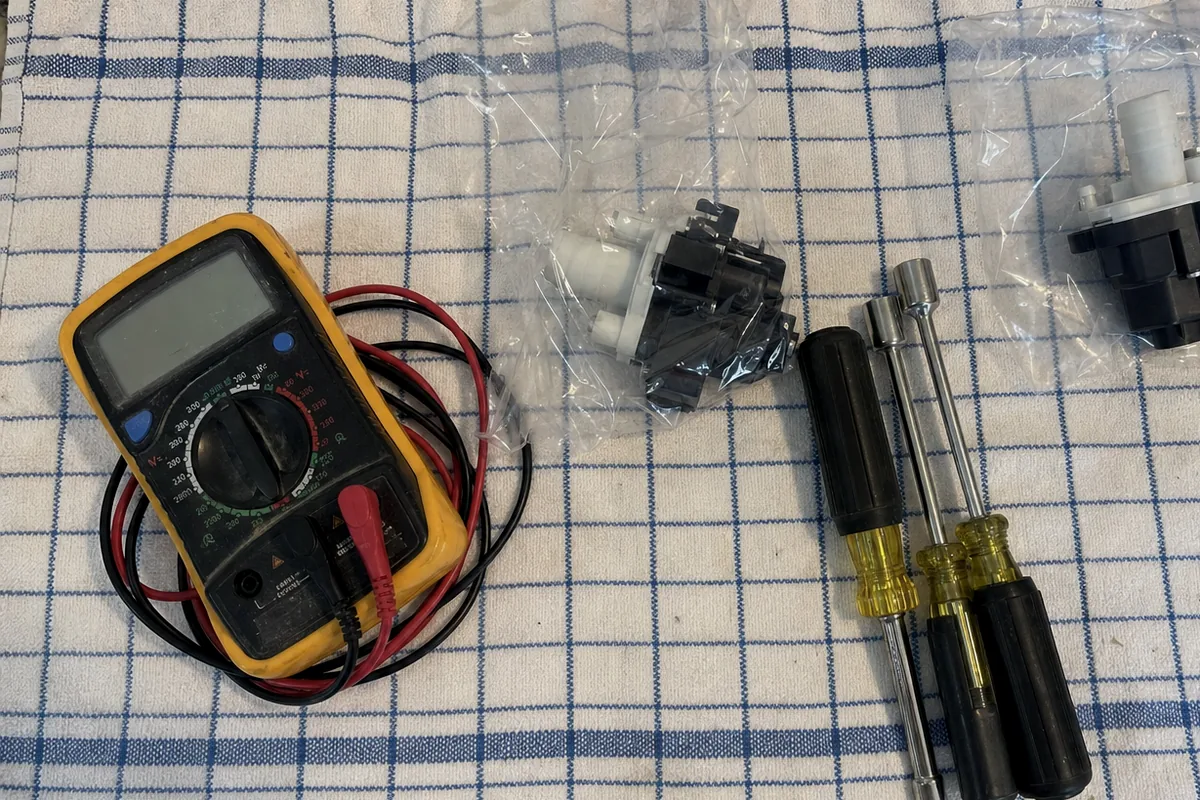
We measure supply at the appliance rather than at the panel, because the fault is frequently between the two. We have found breakers that test as closed and are not passing current, connections cooked at a terminal block, and shared neutrals doing strange things under load. In every one of those cases, fitting a control board would have been an expensive way to learn nothing.
What owners can do before we arrive
If an appliance has gone dark, switch its breaker off, wait a full minute and switch it back on. Some control systems latch a fault state and clear it on a genuine power cycle, and pulling the plug is not the same thing on a hardwired appliance.
Note whether anything else in the kitchen changed at the same time. Two appliances failing in the same week is a supply story far more often than it is a coincidence.
Note whether the failure followed a storm, a utility outage or an outage that came back in stages. That timing is diagnostic and it is the sort of detail we cannot recover later.
Do not run the appliance repeatedly hoping it recovers. If a stage of the electronics is damaged, repeated attempts can take more of it with them.
Protection that is actually worth fitting
Whole-house surge protection at the panel is the only measure that covers hardwired appliances, because a plug-in strip cannot protect a cooktop or a wall oven that has no plug. It is not expensive relative to a single inverter board, and in a market with 68 thunderstorm days a year the case makes itself.
Point-of-use protection still has a role for anything on a receptacle, including some built-in refrigeration.
Neither is insurance. Both shift the odds.
Our part
We diagnose before we quote. Flat $80, credited toward the repair when you approve the work, written estimate before any part is ordered. Where the fault turns out to be in the building’s wiring rather than in the appliance, we will tell you that, put it in writing, and not sell you a board.