The house was not designed for this
A great deal of the housing in Riverside, Avondale and Old Ortega was built between the 1900s and the 1930s. Those kitchens were laid out for an icebox, a sink and a stove, and the electrical service that reached them was sized for lighting and very little else.
Almost every one of those houses has been rewired at least partly since, usually in stages, usually by different people, usually in response to a specific problem rather than as a designed installation. Then a full built-in kitchen arrives: a range, a dishwasher, a wall oven, a cooktop, a refrigerator with its own electronics, and increasingly an induction surface that expects a heavy dedicated feed of its own.
The appliances are fine. What they are plugged into frequently is not.
The symptom pattern
Supply problems in old wiring rarely announce themselves as a dead appliance. They show up as intermittent behaviour that resolves before anyone can look at it, which is the most expensive kind of fault to chase.
A control board that resets when something else in the room starts. An induction zone that drops power for no reason the user can identify. An oven that faults during a long cycle and then tests perfectly for an hour afterwards. A dishwasher that stops mid-cycle occasionally and completes normally the rest of the time. Lights that dim slightly when a compressor kicks in.
Each of those is consistent with a supply that sags under load or with a connection that is marginal rather than open. Each of them can also be caused by an appliance fault, which is exactly why the measurement matters more than the theory.
What we measure, and why at the appliance
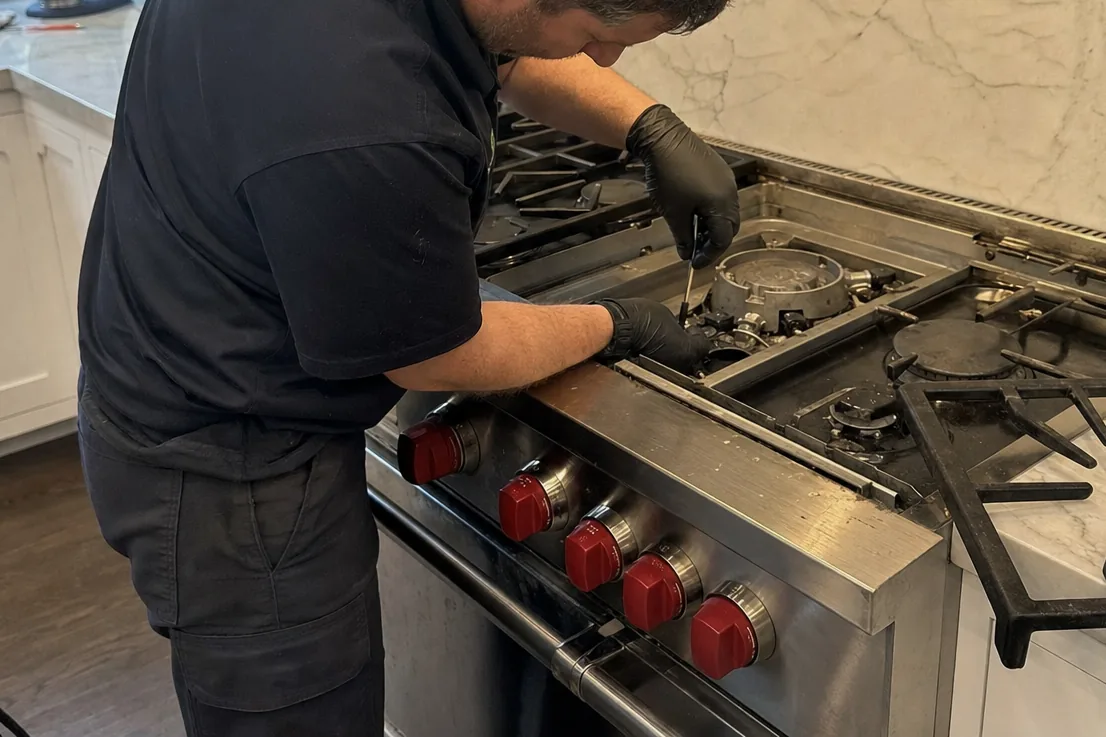
We take voltage at the appliance under load, not at the panel with nothing running. A circuit that reads correctly at rest can drop substantially the moment a heating element or a compressor starts, and it is that drop that upsets control electronics.
On 240-volt appliances we check both legs, because a single weak or open leg produces some of the most misleading symptoms available: half a cooktop working, an oven with a live clock that will not heat, a range that lights on the top and does nothing below.
We also look at what else is sharing the circuit. In these houses a kitchen receptacle circuit can quietly extend into a dining room, a porch or a bathroom.
What we will not do
We will not sell you a control board to fix a wiring problem. It is easy money and it does not work: the new board meets the same supply and behaves the same way, and then the conversation becomes awkward for everybody.
Where we find that the building’s electrical system is the cause, we write it down, explain what we measured, and tell you that the next call belongs to an electrician. That is often not what people want to hear on the day, and it is still the right answer.
Two other constraints in these houses
Cabinet openings in pre-war kitchens are undersized and frequently out of square, even after a remodel. Panel-ready column refrigeration is the least forgiving appliance in that situation, because it has to come forward on its rails to be serviced at all.
And there is the simple question of getting equipment into the room. Doorways, hallway turns and porch steps in a 1920s house were laid out before anyone imagined a 48-inch professional range. If a repair turns into a replacement conversation, that constraint should be part of it from the beginning rather than discovered on delivery day.
Booking
Flat $80 diagnostic, credited toward the repair when you approve the work, and a written estimate before anything is ordered or fitted. We are an independent appliance repair company, licensed and insured in Florida, with no manufacturer authorization of any kind.