A little water is normal. A lot is not
A small amount of water in the sump at the end of a cycle is by design — it keeps seals from drying out. What is not normal is standing water above the filter, a wet floor of the tub at the start of the next load, or a smell that arrives a day after the machine finished.
Most owners assume that means the drain pump. It usually does not. The pump is at the end of a chain of much more likely causes, and it is the most expensive link in it, so we work the chain in order.
One: the filter and the sump
Integrated dishwashers are quiet enough that nobody hears the filter loading up, and the filter is the single most-skipped piece of maintenance in the kitchen. Lift it out — it usually twists free by hand — and look at both the mesh and the sump underneath.
Glass fragments, seeds, labels off jars and, more often than anything else, the foil seal from a bottle are what we find. A partially blocked filter does not stop the machine. It slows drainage, holds soil in suspension so it redeposits on the load, and eventually stalls the pump on a solid object.
Two: the drain path outside the machine
The failure is frequently not in the appliance at all, which is why we ask about recent work in the kitchen.
If the drain hose runs to a garbage disposer that was recently fitted, the knockout plug in the disposer’s inlet may never have been removed. A dishwasher plumbed into a brand-new disposer that has never drained properly is almost always that, and it is a five-minute fix that is not the dishwasher’s fault. If there is an air gap on the counter, it clogs and overflows and needs clearing. If the hose was routed without a high loop or a proper connection to the air gap, the sink drains back into the machine and the standing water is not even the dishwasher’s own.
Three: the check valve and the hose itself
Between the pump and the hose sits a non-return arrangement that stops discharged water falling back into the tub. If it is held open by debris, the machine drains and then refills itself from the hose, which reads exactly like a pump that never ran.
The hose is worth its own look. Behind a fully integrated machine it can be crushed by the appliance being pushed back into the cabinet during a remodel, or kinked where it passes under a cabinet floor. That produces a machine that drains slowly rather than not at all, and drains slowly is what owners describe as “it started leaving water in the bottom”.
Four: then the pump
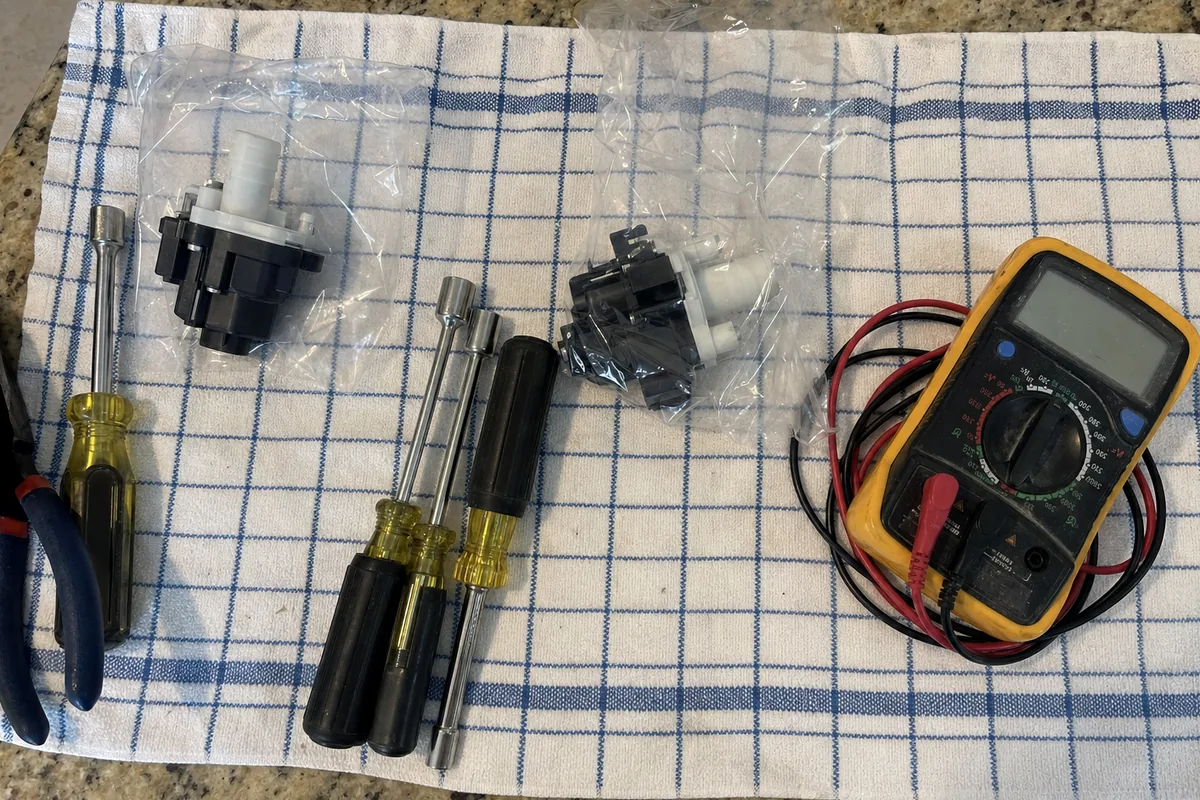
Only after the first three do we look at the pump and its electrical supply. A drain pump that hums and does not move water is usually obstructed rather than dead, and a pump that is silent may be a wiring or control problem rather than a motor. Both cases need measurement, not assumption.
If a pump genuinely has failed, the part depends on the serial range as much as on the model, so we read the plate on the inner door edge before ordering anything, and the price and the wait go in the written estimate.
Two things to check before you book
Run the machine empty on a normal cycle, listen for the drain phase, and note whether it happens at all. Then open the door at the end and see whether the water sits above or below the filter. Those two observations, plus whether anything was recently changed under the sink, narrow the diagnosis considerably before we arrive — and occasionally solve it without a visit, which is a fair outcome for everyone.