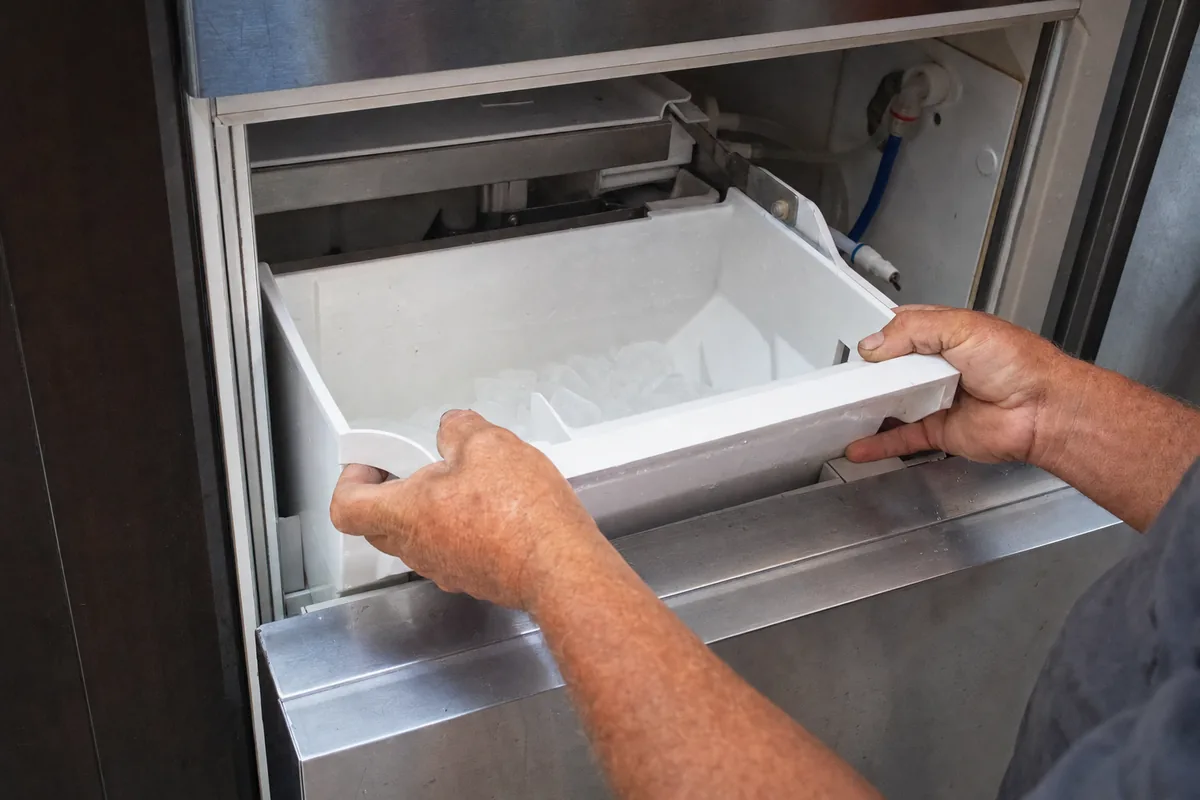
A small machine bolted inside a big one
An ice maker is its own appliance: a valve, a fill tube, a mould, a heater, a motor and a control, all living inside a freezer that is trying to keep everything around them frozen. It is the most-replaced assembly in a built-in freezer column, and it is also the assembly most often replaced when it did not need to be.
The symptom tells you a great deal if you read it carefully, because the three common complaints point at three different parts of that little machine.
No ice at all: follow the water
Nothing in the bin, and the mould is dry. That is a supply problem until proven otherwise, and the supply starts a long way from the freezer.
We check the shut-off first, which on a built-in column is frequently the whole answer — closed during other work, or finished into cabinetry where nobody can reach it. Then the supply line for a kink behind the unit, then the water filter if the appliance has one, since a filter long past its interval restricts flow before it does anything else. Then the inlet valve and its screen. Only after that does the ice maker itself come into question.
There is a second family of causes on the cold side. A freezer compartment that is not holding a proper freezing temperature will not complete a cycle, so a warm compartment is an ice-maker complaint dressed up as an ice problem. A frosted-over fill tube is the classic version: a small leak at the valve lets water sit in the tube, it freezes, and the next fill has nowhere to go.
Hollow cubes and short fills: measure the fill
Cubes that come out thin, hollow or half-formed usually mean the mould is not receiving a full charge of water. That is flow, not freezing: a restricted filter, a partially open shut-off, a screen at the inlet, or a valve that no longer opens fully. Occasionally it is fill timing on the control.
The reason to distinguish it from a mould fault is money. The mould assembly is the expensive part and the valve is not, and a valve that under-delivers is the more common of the two by a wide margin.
Fused slabs and a failed harvest: look at the release
Cubes welded into one slab, or a bin that has a single solid block in it, is a harvest and storage problem rather than a fill problem.
Harvest is the step where the mould is warmed just enough to release the ice and the ejector sweeps it into the bin. If release is incomplete, the next fill lands on top of what did not leave, and the bin fills with a solid mass. Causes sit in the harvest heater, the motor and gearing, or the control that sequences them. A separate and very common cause is the bin itself: ice that sits unused for weeks slowly sinters into a block, which is a usage pattern rather than a fault. If the house empties for a month at a time, that is worth knowing before anyone buys a part.
What we check, and in what order
Freezer temperature first, because nothing else means anything if the compartment is not cold enough. Then the water path from the shut-off inward. Then fill volume, watched rather than assumed. Then the harvest cycle, forced and observed end to end. Then, and only then, the assembly itself.
Access is part of the job on a panel-ready column. The unit comes forward on its rails with the doors unloaded and the floor protected, the anti-tip fixing released properly, and the water line handled so it is not stretched or kinked on the way out. That takes planning, and it is the reason this repair is quoted as a proper visit rather than a ten-minute swap.
Prevention that actually works
Change the water filter on the interval rather than when the indicator becomes irritating — it is the cheapest maintenance available on this appliance. Keep the condenser area clear and have it cleaned on a schedule, because a refrigeration system working harder than it should shows up in ice production before it shows up anywhere else. And if the bin sits untouched for long periods, empty it occasionally rather than letting a slab form and calling it a fault.